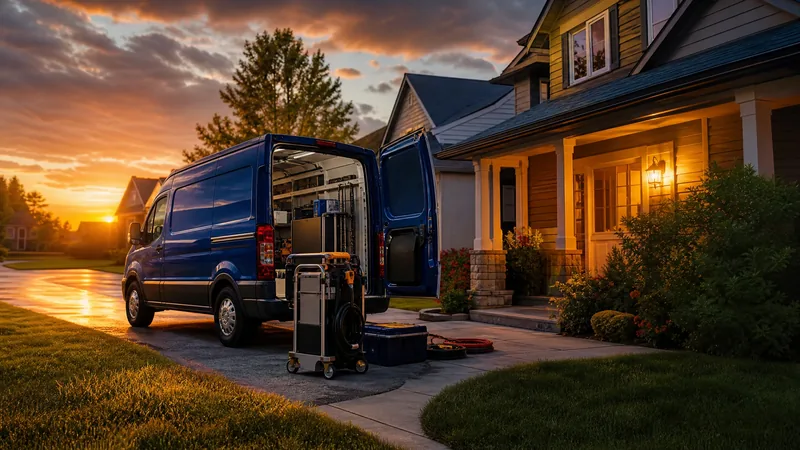
How to Start a Landscaping Business in South Dakota: Sales Tax on Mowing and Spraying, 2% Excise Tax on Pavers and Retaining Walls and the $35 Pesticide Applicator License
Landscaping in South Dakota is taxed by the type of work you perform, not by the label on your truck. Mowing, trimming, fertilizing, weed control and spraying fall under the state sales tax. Pavers, retaining walls, patios and sprinkler installation fall under the 2% contractor's excise tax. If you spray pesticides on someone else's land, you also need a commercial applicator license from the Department of Agriculture and Natural Resources. This guide walks through the registrations in the order you should handle them, with the costs, deadlines and tax treatment for each.
Disclaimer: This article is informational content, not legal or tax advice. Tax treatment depends on how each contract is written and how each invoice is itemized. Talk to a qualified attorney or certified public accountant (CPA) before you form your business or file tax returns, and confirm current figures with the agency named in each section.
What You Need Before You Start
Gather these items before you file anything. Some are free, but the entity filing and the pesticide license carry fees, and a few have deadlines that are easy to miss.
- A business name that is available on the state business search
- Articles of Organization (LLC) or Articles of Incorporation (corporation), or a plan to operate as a sole proprietor under a DBA
- A South Dakota registered agent with a physical street address in the state, plus a mailing address if it is different
- A free sales tax license from the Department of Revenue
- A free contractor's excise tax license if you will build hardscape
- A commercial pesticide applicator license if you spray on other people's property
- An underground irrigation license from the State Plumbing Commission if you install sprinklers
- Invoice templates that list sales-taxable services and excise-taxable work on separate lines
- A filing system for client exemption certificates and supplier invoices
Step 1: Choose a Structure and Check Your Name
Many landscaping owners choose a limited liability company (LLC) because it separates personal assets from business debts. South Dakota has no personal or corporate income tax, and LLCs pay no franchise tax. Forming an LLC costs $150 online or $165 by paper. Online filings are processed immediately upon payment, while paper filings average 1 to 3 business days.
Your name must contain Limited Liability Company, Limited Company, or the abbreviation L.L.C., LLC, L.C., or LC. You may abbreviate Limited as Ltd. and Company as Co. The name must be distinguishable on the record from existing registered names. Search the South Dakota business search before you commit, then file through SOSEnterprise. If you need more time to finish paperwork, you can reserve a name for 120 days for $25 using the Secretary of State name reservation form.
A corporation files Articles of Incorporation for a domestic business corporation at the same $150 online fee. Most landscapers do not need a corporation, but your attorney or CPA can tell you whether it fits your plans.
If you want to operate under a trade name without forming an entity, file a fictitious business name (DBA). It costs $10 per name, is valid for five years, and costs $10 to renew or amend. Canceling it is free. You can file online with the Secretary of State or by paper at any county Register of Deeds office. A DBA does not create a separate legal entity, so it does not give you the liability protection of an LLC.
Step 2: Appoint a Registered Agent
Every registered entity must continuously maintain a South Dakota registered agent with a physical street address in the state, plus a mailing address if it is different. The agent can be a noncommercial registered agent, which means an individual resident or a registered business entity, or a commercial registered agent listed by its CRA number under SDCL 59-11. If you are the owner and you live in South Dakota, you may be able to serve as your own agent. Confirm the address rules before you file, because a missing or incorrect agent address can cause problems later.
Step 3: Calendar Your Annual Report
The annual report costs $55 and is due on the first day of the anniversary month of your original filing, every year. The filing window opens two months before the due date. If you miss the due date, the entity becomes delinquent two months later and begins accruing late fees. Put the date on your calendar the day your formation is approved. If you need the paperwork completed sooner than the normal course of business, you can request expedited handling for a $50 expedite fee.
Step 4: Get Your Free Sales Tax License
South Dakota has no general statewide business license. The registration most landscapers need first is the sales tax license from the Department of Revenue. It is free, and any business with a physical presence in the state must hold it before making taxable sales. The $100,000 gross sales threshold applies only to remote sellers with no physical presence in South Dakota, so it does not apply to a local landscaping business. Apply through the Department of Revenue sales tax permit portal, or start at dor.sd.gov.
The state sales tax rate is 4.2% through June 30, 2027. It is scheduled to return to 4.5% on July 1, 2027, under SDCL 10-45-2. Cities may add a municipal tax of 1% to 2% on top of the state rate, so check the rate in each city where you work. Counties do not levy a sales tax. South Dakota taxes most services, not only goods, so your mowing and spraying invoices are taxable. If you sign multi-year maintenance agreements, review how the July 2027 rate change will affect those invoices.
Step 5: Sort Every Service Into the Right Tax Bucket
The Department of Revenue's Landscaping and Lawn Care Tax Fact (June 2024) splits the work into two groups. The sales tax list applies when the work is done apart from a realty improvement contract. The contractor's excise tax applies to hardscape and construction-type work.
| Tax treatment | Services |
|---|---|
| Sales tax (state rate plus any municipal tax) | Aerating, dethatching, fertilizing, hydro seeding, decorative rock and weed-fabric installation, killing weeds, insects, rodents or fungi, landscape design, sprinkler start-up and blow-out, mowing and trimming, mulching, planting and pruning ornamental trees and shrubs, tree and stump removal, raking, seeding, snow removal, sod laying, spraying, tilling, turf installation (except artificial turf), watering |
| Contractor's excise tax (2%) | Land clearing, artificial turf, brick, pavers and block (including around a flowerbed), driveways, sidewalks, patios, decks, gazebos, retaining walls, ponds, fountains, masonry, sprinkler system installation |
| Follows the project | Soil moving or grading, which is taxed with the project it supports |
Sod, plantings and mulch sold on a standalone job are sales-taxable. The same materials used inside a patio or wall project fall under the excise rules. If a job combines both, ask the Department of Revenue how to classify it before you send the estimate.
Step 6: Handle Mixed Jobs Correctly
Most real projects mix both categories. A backyard renovation might include sod, shrubs, a patio and a retaining wall. South Dakota gives you three ways to handle a mixed contract:
- Use the primary purpose of the contract to decide how the whole job is taxed.
- Itemize the taxable and excise-taxable parts on separate lines.
- If 25% or more of the contract is excise-taxable work, charge excise tax on the whole contract.
For example, a $10,000 quote that includes $3,000 of patio and retaining wall work is 30% excise-taxable work. The 25% rule applies, so the full contract would carry the 2% excise tax. If you itemize the same job instead, the sod and plantings can stay on the sales tax side. Itemizing requires clean invoices and clear contract language, so build your estimate template before your first bid.
Step 7: Understand the Resale Rules for Materials
South Dakota does not use a resale certificate. Instead, the buyer gives the seller an exemption certificate. The rules depend on the type of job:
- On sales-taxable jobs, plants, sod, soil, mulch, fertilizer and lawn chemicals sold to the customer may be bought for resale.
- On excise-taxable jobs, no materials may be bought for resale, so you cannot use a resale exemption for pavers, block or other supplies.
Keep the exemption certificates you give suppliers and the ones you collect from clients in the same file as your invoices. Missing paperwork is one of the most common reasons a sales tax review turns into an audit problem.
Step 8: Get the Free Contractor's Excise Tax License
Contractors must hold a free contractor's excise tax license from the Department of Revenue before starting work. A business that mows lawns and also builds patios needs both the sales tax license and the contractor's excise tax license before it begins any hardscape job. South Dakota has no state general contractor license. Electricians and plumbers are licensed by state commissions, which is a separate process from this one.
Step 9: Get the Commercial Pesticide Applicator License
If you spray pesticides on another person's land, you need a commercial applicator license from the Department of Agriculture and Natural Resources (DANR). This is the license most people mean when they search for a South Dakota pesticide applicator license. The key facts are:
- Fee: $35
- Expiration: March 31 of the second year after issue (SDCL 38-21-17 and 38-21-17.1)
- Exam: a score of at least 70% (ARSD 12:56:05:01)
- Recertification: every two years
- Penalty for spraying without a license: a Class 2 misdemeanor, plus a civil penalty of up to $5,000 per violation
As an example, a license issued in late 2026 would expire March 31, 2028 under this rule, but confirm the date on your own license. Check the exam schedule, study materials and application steps directly with DANR before you plan your first season. Mowing alone does not trigger this requirement. Spraying herbicide, insecticide or fungicide on a customer's property does.
Step 10: Add Irrigation Licensing for Sprinkler Work
Sprinkler system installation is excise-taxable at 2%, and it also requires an underground irrigation license from the State Plumbing Commission. Under the 2025 fee rule (ARSD 20:53:12), the contractor license costs $200 per year and the installer license costs $105 per year. Confirm current fees with the Commission before you bid, because fees can change. Sprinkler start-up and blow-out visits are sales-taxable services, so put them on their own line.
Step 11: Check City and County Requirements
South Dakota has 66 counties and 310 incorporated places. Most cities license only specific trades, not every business, so ask your city clerk whether a local registration, business license or permit applies to your work. Also ask about the municipal sales tax rate in each city you serve. Counties do not levy a sales tax, so tax filings run through the state. For free planning help, the South Dakota Small Business Development Center and the SBA South Dakota district page list local resources.
Common Mistakes to Avoid
- Telling customers that landscaping is tax-exempt. Mowing, trimming and spraying are taxable services in South Dakota.
- Waiting until you reach $100,000 in sales to get a sales tax license. The license is free and required from the start for any business with a physical presence in the state.
- Searching for a single South Dakota landscaping license and assuming it covers everything. The state has no landscaping license, so you assemble registrations based on the services you offer.
- Quoting a patio, wall and planting job as one lump sum without itemizing, which can push the whole contract into excise tax under the 25% rule.
- Using a resale exemption for pavers or block on an excise-taxable job.
- Spraying a customer's lawn before the pesticide applicator license is in hand.
- Forgetting the annual report, the license expiration date or the two-year pesticide recertification.
- Ignoring the scheduled July 1, 2027 change from 4.2% to 4.5% on multi-year service agreements.
- Installing a sprinkler system without the required irrigation license.
Expected Results
Separating your services and licenses from the start may help you price jobs accurately, file sales tax returns with fewer corrections, and answer client or agency questions with records instead of memory. Results depend on your client mix, pricing and recordkeeping habits, and no specific outcome is guaranteed. Owners who organize invoices and renewal dates in their first season may find that fewer surprises come up at renewal time.
Launch Checklist
- Search the business name and reserve it if needed ($25 for 120 days).
- File Articles of Organization online ($150) or by paper ($165).
- Appoint a South Dakota registered agent.
- Register for the free sales tax license.
- Get the free contractor's excise tax license before any hardscape work.
- Obtain the $35 commercial pesticide applicator license before spraying anyone else's property.
- Obtain the State Plumbing Commission irrigation license before installing sprinklers.
- Calendar the $55 annual report, the license expiration dates and the July 1, 2027 tax rate change.
Confirm every figure above on the official agency page before you act: the South Dakota Secretary of State for entity filings, the Department of Revenue for tax licenses, DANR for the pesticide license, and the State Plumbing Commission for irrigation licensing. For complex entity choices or mixed contracts, talk to a qualified attorney or CPA. This article is informational, not legal or tax advice.
Keep exploring: related South Dakota guides
- How to Start a Hunting or Fishing Guide Business in South Dakota
- How to Start a Meat Processing Business in South Dakota
- How to Start a Custom Harvesting or Ag Services Business in South Dakota
- How to Start a Pheasant Lodge or Commercial Shooting Preserve in South Dakota
- How to Start an LLC in South Dakota
- South Dakota Business License
- How Much Does It Cost to Start a Business in South Dakota
- All South Dakota business types
- Every South Dakota guide in one place